Working copy
Draft text, rebuilt from the manuscript on every change. Stubs and source passages are still here, and none of it is final. Back to the working copy contents
Drafted The chapter is written and still being revised.
The tender is the API
In February 2023 the editor of a science fiction magazine closed his door. Clarkesworld had taken stories from anyone since 2006, paid for the ones it printed and answered every writer within days. That made it a target. When a chatbot that could write a passable story became free, people who had never written one started sending stories in, following advice going around online about easy money. By the twentieth of the month the magazine had received about five hundred machine-written stories and about seven hundred real ones. Neil Clarke, the editor, could no longer sort the two piles fast enough to keep reading, so he stopped taking submissions at all. The real writers lost their door along with the fakes.
A magazine is a small door. A public tender is a bigger one, and the same crowd is on its way.
Perhaps the procurement process for construction should be redescribed in terms of software development. There are three components. The design. The tender, which is the API. And the compilation, which is construction itself. The design and the compilation negotiate through the tender, and the builder agrees, in an auction, to provide all the resources needed to compile the design. Readers who know the software world will recognize the Amazon mandate of 2002, as Steve Yegge told it years later in a post that escaped onto the open internet. Every team will expose its data and its functions through a service interface. No team will reach into another team's code. Anyone who does not comply will be fired. In construction the teams are a design consultant and a builder, and the interface is the tender package.
The virtue of an interface is that nobody has to read the other side's source code. The designer need not know how the builder schedules its crews. The builder need not know why the engineer chose that beam. Neither has to show its own, and neither would want to. Exposing the source code to strangers is an invitation for exploitation. The bill of quantities is the call every bidder makes, and the bid is the answer that comes back.
A single interface has a second virtue, and it is the one a court cares about. One door means one builder answers for everything behind it, whoever it hires to do the work. On most public work in North America a bonding company stands behind that builder and pays if the builder fails. Chapter 4 prices the alternative. Hire a Construction Manager to buy from the trades on your behalf, and accountability is what you trade away.
The interface, though, is a stack of PDFs. They are enormous files that machines read unreliably. They carry no metadata a bot can use, and they look terrible on the phone of the person who has to build from them. Nobody would choose them for a digital industry today, and yet they rule.
William Sewell, in "Three Temporalities", writes some good prose about the Paris workers' revolt of June 1848 in support of his eventful temporality: the idea that the mechanisms of social life are best understood through the order of events. If we wanted to add a mundane example, the persistence of PDF documentation surely provides the strongest support for his system. Its dominance as the digital contracting tool is only a relic of the events of the past. No one would argue that a teleological or an experimental temporality would better explain it.
The standardization of paper sizes in the 20th century allowed for the commoditization of communications. The printers, copiers, and fax machines could all interact to produce an analog final version of a digital product, and the PDF carried that paper sheet into the digital age. Times have changed, and the tool has become a horde of monsters. Every drawing, specification and addendum is a zombie shambling on your phone, needing constant zooming and focusing to read, colonizing your computer screen with unnecessary margins, and refusing every change a person or a bot might want to make.
The PDF is an undead protocol. As a technology it died with the fax machine, but as a protocol it kept walking, because the paper set it imitates carries the engineer's seal and the contract's signatures. The file inherited the paper's place in the law: the copy that is stamped, issued and frozen, the one a court reads when a dispute arrives. Construction procurement has built a walled garden around these zombies to control their damage, but refuses to kill them. Only the people who live alongside them, the buyers, consultants, bidders and courts, can decide to. In software terms, the contract is written on the one medium the compiler cannot open.
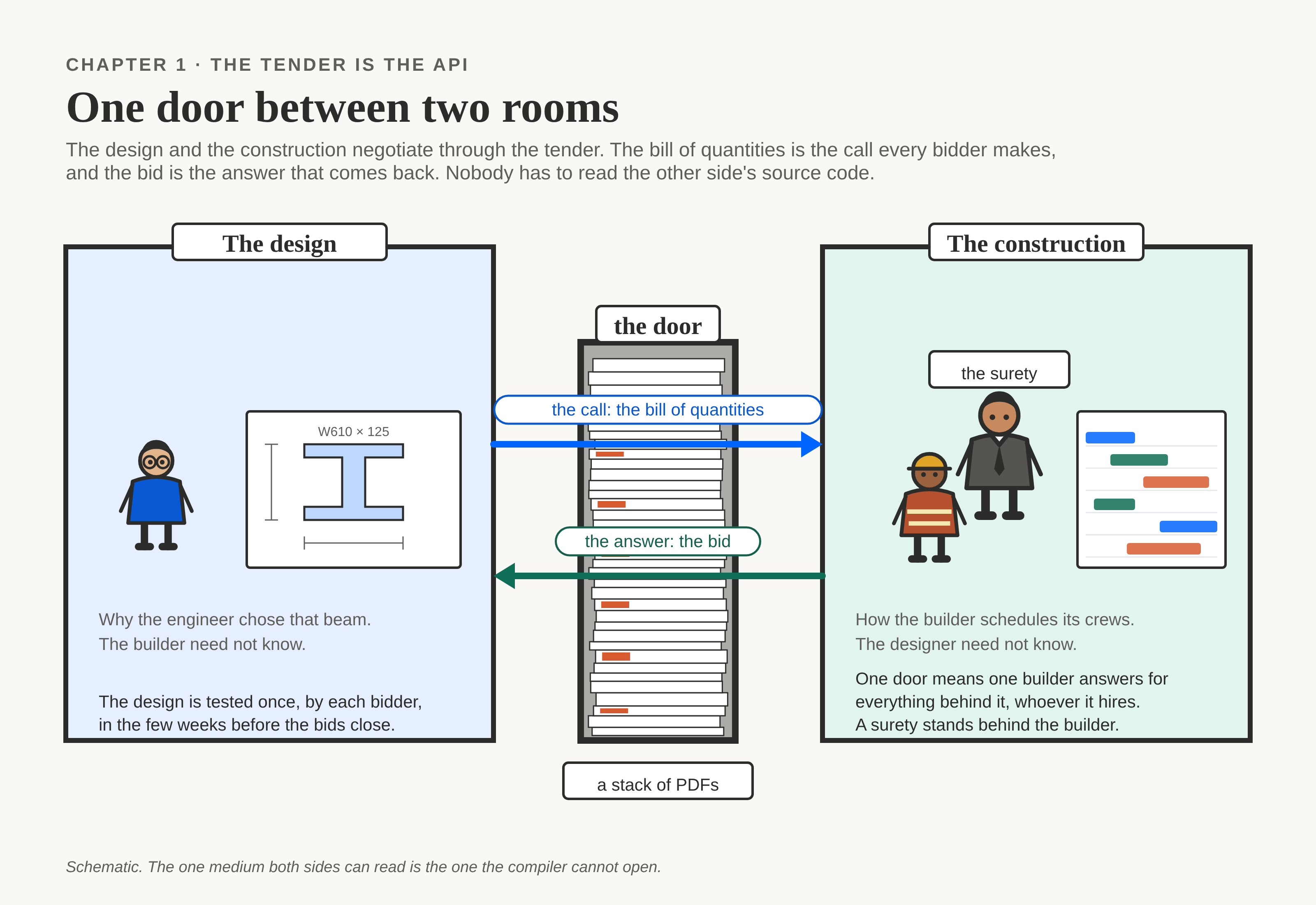
The design side is no better tested. BIM modelling, AI review and licensed professionals help screen for errors, but bug-free drawings are still a mythical beast. Every other interface in the world is tested by calling it thousands of times before anyone depends on it. A tender is called once, by each bidder, in the few weeks before the bids close, and the errors it hides are found by the people least placed to say so. That is the divorce of chapter 2. A rich enough building model would be the specification itself, and bots would rather read the model's files than the drawings made from it. The catch is that the designer carries more cost and more risk, because paper can be checked by eye far more easily than the code behind a high-rise. In several countries the interface already exists in a plainer form, where the bid travels as a file the owner writes and the bidder fills in. A later chapter visits them. This chapter is about the traffic through the door.
The cost of a call
Every interface has a price per call, even when nobody writes it down. For a tender, the price is what it costs a firm to read the documents, measure the work, price it and write up the parts the buyer intends to score. For most of the industry's history that price was high, and it shaped the market more than any rule did.
Public buyers wrote the price up themselves, with reason. A public body cannot profit from a success, but it answers for every failure, so its specifications are long and its contract terms lean on the bidder. A firm that reads all of it, prices the work and writes a technical proposal is spending real money on what will probably be a sunk cost. Most firms don't. The European Court of Auditors counted the result. Between 2011 and 2021 the share of public contracts in the European Union with a single bidder nearly doubled, to 42 percent, and the average number of bidders fell from about six to three. The auditors named the causes: administrative burden, over-restrictive criteria, tailor-made specifications and market concentration. Ontario's Auditor General found that the firms answering the province's calls for major projects fell from more than five in 2014 to about two and a half. Four of thirty public-private partnerships, each worth over a billion dollars, drew a single bid. One place a buyer pays for the call outright is American design-build; Ontario's public-private partnerships pay a proposal fee too. Federal rules there let an agency pay the losing teams a stipend, usually a third to a half of what the proposal cost them. The rules say why. The stipend is meant to encourage competition and to keep smaller companies from being put at a disadvantage.
Think of that cost as a large oak. For a century it stood over the market and shaded out everyone who could not afford to grow under it. A firm needed an estimating department, a bonding line and the patience to lose five bids in six to live in its shade. The buyer's systems grew in the shade too. The plan room, the three-week tender period and the evaluation committee were built for the mature forest under one tree, with a few large bidders, a manageable stack of bids, and time to read them.
The oak falls
Then AI made the call nearly free.
The flood arrived first where the door was smallest. Clarkesworld was February 2023. By 2026 the arXiv preprint server, which has carried the world's physics and computer science papers since 1991, had a record forty thousand submissions in a single month. It capped every submitter at two papers a month and tightened who may vouch for a newcomer. About 40 percent of the proposals firms sent to the European Union's research programme showed signs of AI editing by the end of 2024, and younger and less innovative firms had adopted it fastest. One Irish tender evaluator, who also sells an AI bid-review tool, watched competitions that drew three or four bids in 2023 draw twelve to fifteen. Construction's priced bids have not been measured yet, and this chapter will come to the reason.
Picture the oak falling. Where it stood there is a clearing, and the clearing fills with a thicket racing for the new sunlight. There are more plants than anyone can count, and the old systems, built for the mature forest, cannot cope. Every seedling in the thicket looks much like the next, which is the point. A polished bid used to prove something, because writing one took a week and someone who knew the work. Two economists watched that proof die on a freelance platform. Before AI writing tools, employers paid a premium for applications tailored to the job. After, the premium vanished, and their model of that market says the best workers would be hired less and the weakest more. The polished bid is now only polish. The market has never been busier, and its bids have never said less.
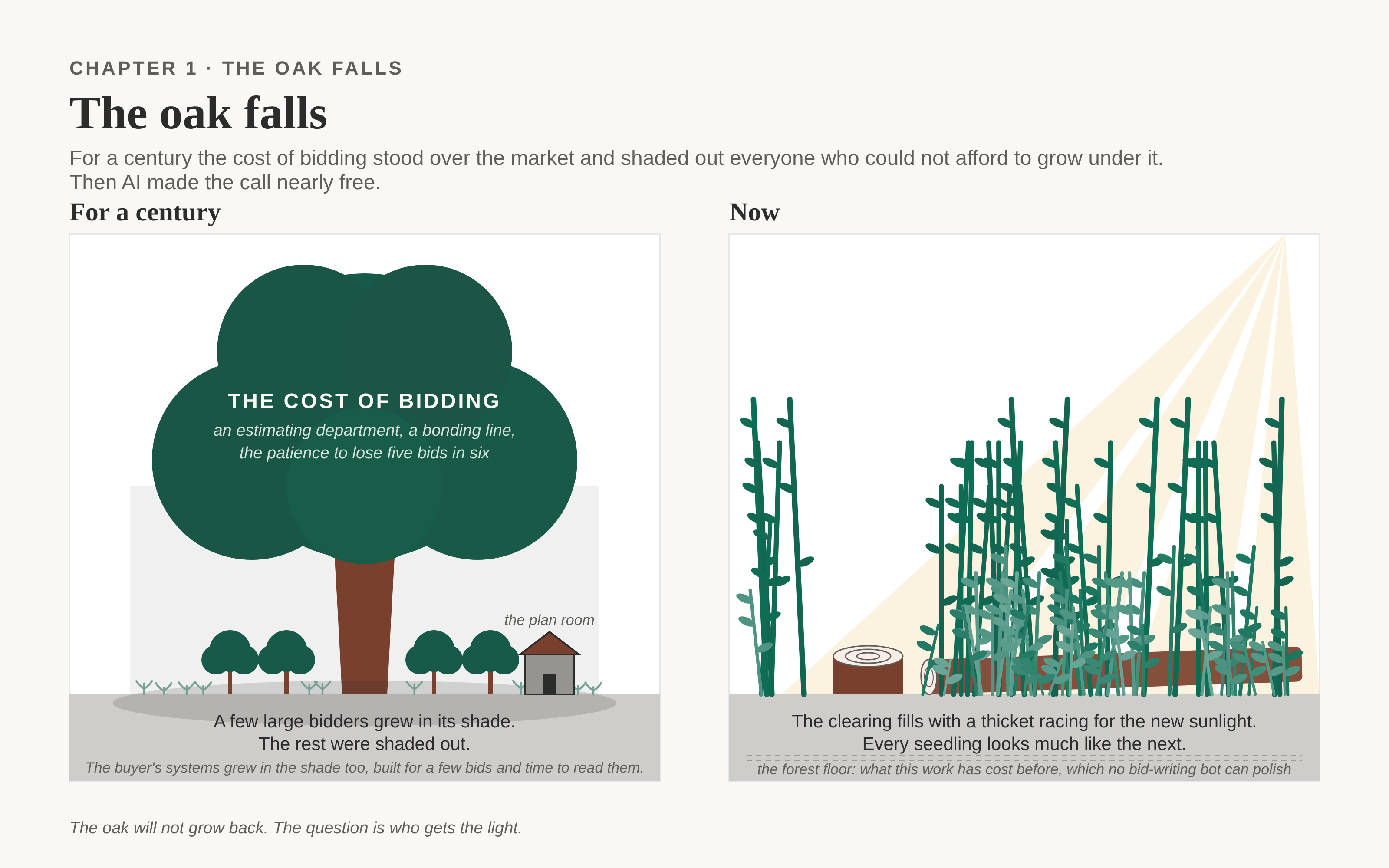
What the thicket cannot fake is the forest floor. A market's memory is its record of what this kind of work has cost, on this kind of job, in this region, under these conditions. A buyer can hold a thousand bids up against that record, and no bid-writing bot can polish it, because it did not write it. One warning comes with the memory. If one company owns the record, and its bot reads for the buyer while its other bot writes for the bidders, the memory stops being the market's. A study of hiring found that a screening model favours résumés written by the same model, shortlisting them up to 60 percent more often. Put the same bot on both sides of a tender and the clearing belongs to one plant. Keep the record public, and keep it plural.
Slack, and the other option
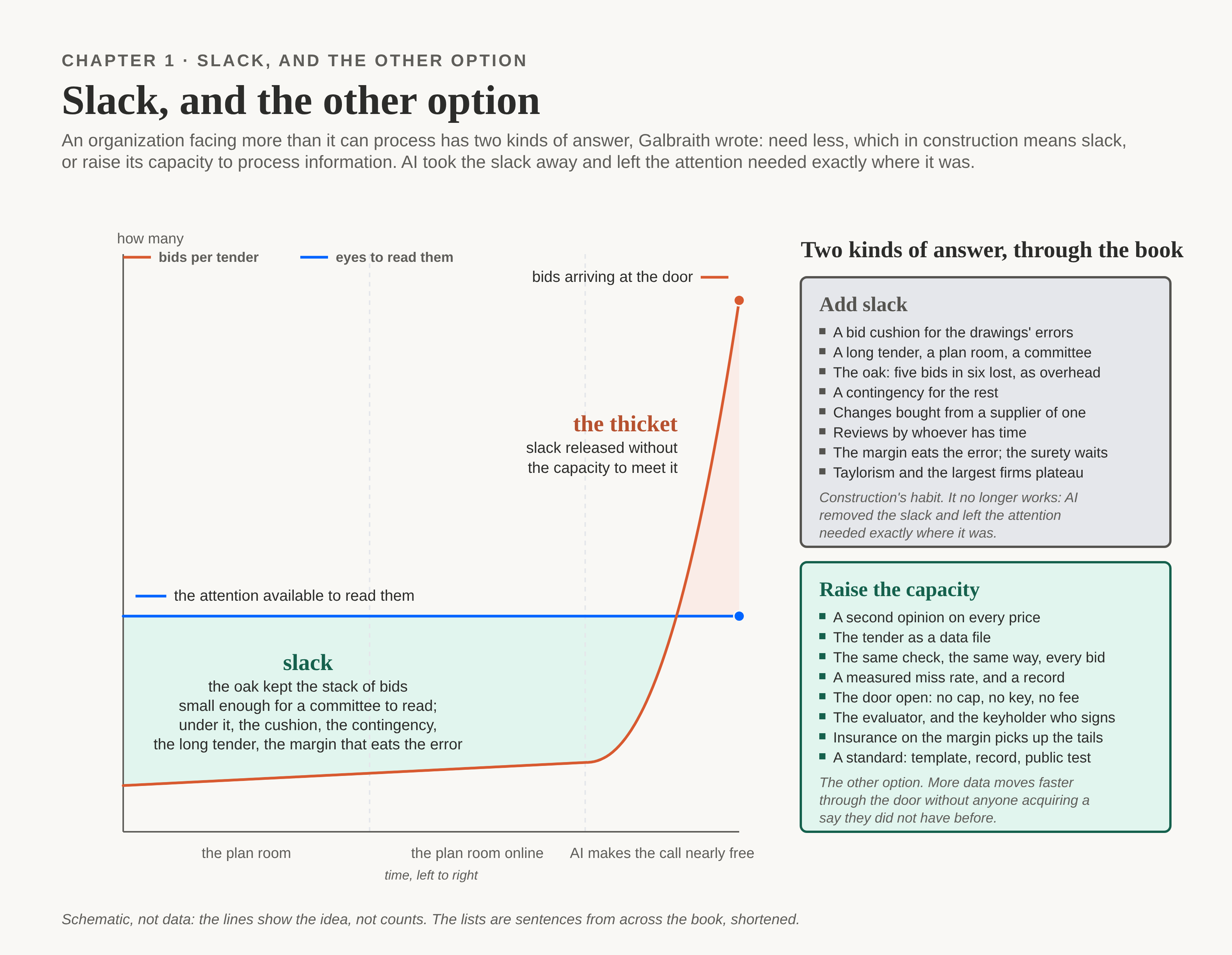
The organization theorist Jay Galbraith wrote, in the late 1960s and the 1970s, that an organization facing more uncertainty than it can process has two kinds of answer. It can need less, and the commonest way to need less is slack: more time, more money and more cushion between the parts, so that nobody has to know everything. Or it can raise its capacity to process information, with better systems and shorter lines between the people who need to talk.
Construction has always chosen slack. The tender period is long. The bid carries a cushion for the errors in the drawings, and the contingency carries a cushion for the rest. The oak was slack too, a cost so high that only a few could pay it, which kept the stack of bids small enough for a committee to read. Moving the plan room onto the internet did not change this. It raised processing capacity by removing the need to travel to bid, but the actual attention needed remained the same. AI did not remove the uncertainty either. It removed the slack, and left the attention needed exactly where it was. The thicket is slack released without the capacity to meet it.
A public buyer cannot simply hire more readers. More bidders are what the public wants from it, since an open door is what keeps out nepotism and bid-rigging, but more staff to read the bids is a hard thing to ask a legislature for. The public would rightly ask why the public servants don't use AI to evaluate the bids. The honest answer is too technical for a press release. An AI that scores bids can give two answers to the same bid. Someone has to pick one, and whoever picks has gained a say in who wins, which is exactly the discretion that strict tender rules exist to take away. Without a standard, AI scoring would invite a claim. The first such claim has already been to court. A losing bidder on a US Army contract worth about $450 million said the evaluators' AI tool had invented a weakness in its proposal. It lost, in September 2026, because it could not trace an error in the evaluation to the tool. The judge ordered the tool's output added to the record all the same, after the government's account of who had seen it changed in the middle of the case. The court could not tell what the AI had done, and that missing record is the standard's argument.
The standard is the other option, Galbraith's improved capacity. The same check, applied the same way to every bid, lets more data move faster through the door without anyone acquiring a say they did not have before.
Four ways to answer a flooded door
Software has met this flood before, and it has four answers to a flooded interface. It can limit how often anyone may call, which engineers call a rate limit and this chapter will call a cap. It can decide who may call, with a key. It can charge for each call, a fee. Or it can check every call against rules that everyone can read, a published check. Construction has a twin for each, and the twins show which answers a public buyer can live with.
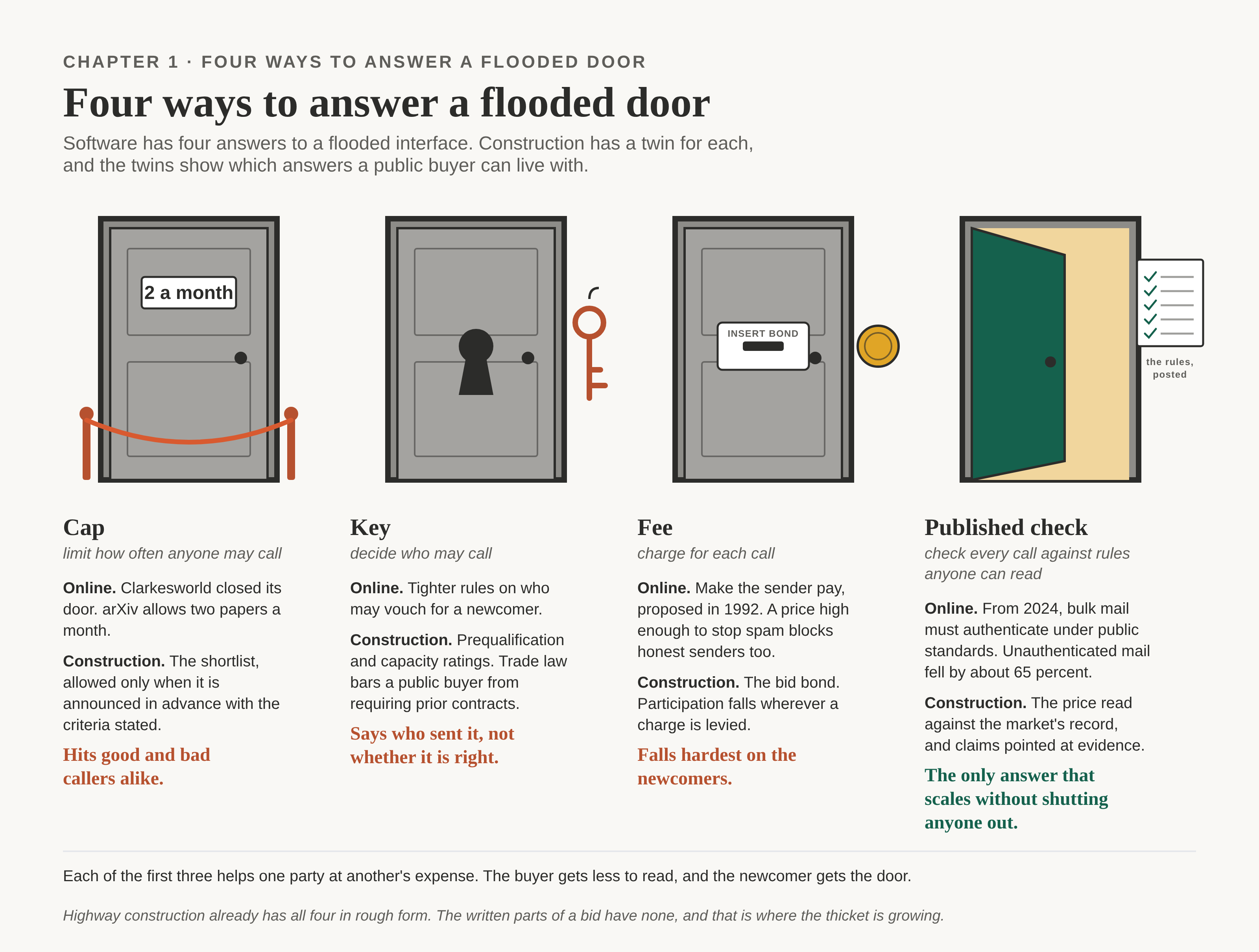
Caps. Clarkesworld's closed door was a cap, and it turned away seven hundred real stories to stop five hundred fakes. arXiv's two papers a month fall on established authors too. Construction's cap is the shortlist. Trade law allows it only when it is announced in advance with the criteria stated. A cap hits good and bad callers alike.
Keys. A key says who sent the request, not whether it is right. arXiv tightened who may vouch for a newcomer. Construction has prequalification and capacity ratings. Trade law already bars a public buyer from requiring prior contracts, because tight keys favour the firms already inside. A private buyer can decide it is willing to pay a premium to consider only established companies. A public buyer that did the same would find itself in a conflict of principles.
Fees. Making the sender pay is the oldest idea in the fight against junk mail, proposed in 1992, and the most carefully studied failure. In 2004 Ben Laurie and Richard Clayton worked out what a price high enough to stop spam would do to everyone else. The price at which spam stops paying is of the same order as what ordinary users send, and it would block a measurable share of an internet provider's honest customers. Their conclusion was blunt: proof of work will not be a solution to spam. Construction's fee is the bid bond. It does screen out desperate bids, and the United Nations' guide to its model procurement law notes that participation falls wherever a charge is levied. Several countries swap the bond for a signed declaration below a threshold so that small contractors can bid at all. The fee falls hardest on the newcomers a public buyer is supposed to welcome.
Each of the first three helps one party at another's expense. The buyer gets less to read, and the newcomer gets the door.
The fourth answer is the only one that scales without shutting anyone out, and email is again the proof. From 2024, two of the largest mail providers required every bulk sender to authenticate under public standards. Unauthenticated mail reaching the larger one's users fell by about 65 percent, some 265 billion messages in a year, and legitimate senders were spared the fee that would have blocked some of them. Two findings say why a published check wins as the flood grows. Louis Kaplow showed in 1992 that a rule costs more to write once and less each time it is applied, while judgment costs the same every time, so the more often a question comes up, the better a rule pays. A flood is that frequency. And Noise, by Kahneman, Sibony and Sunstein, reports an insurer that asked its underwriters to price identical cases. They differed by a median of 55 percent, where the executives had expected about ten. Bids judged case by case carry the same noise, and a protest is a bidder who has noticed.
Highway construction, as it happens, already has all four answers in rough form: prequalification, a bid bond, a bid file the owner writes and the bidder fills in, and bid reviews with written reasons. Nobody has shown that priced highway bids flood, though nobody has measured it either, and the Texas lettings have drawn more bids each year since 2023. The written parts of a bid, the qualifications, the method statements and the technical proposals, have none of the four. That is where the thicket is growing.
The check has one more rule to obey. Paul Graham's spam filter of 2002 worked because spam had to say spammy things. To beat it, he wrote, spammers would have to make their mail indistinguishable from yours. AI-written bids already are. So the check cannot be a check of the prose. It has to look at what the prose cannot change, the price read against the market's record and the claims pointed at evidence.
What thins the thicket
A thicket does not stay a thicket. Something thins it. In a forest it is the first plants to reach the canopy, which shade out the rest until the forest is mature again, with new trees in it. In the tender it will be one of three things. Noise, where the buyer reads a sample and the award becomes a lottery with better prose. Capture, where one vendor's bot reads for the buyer and writes for the bidders, and the market's record becomes its property. Or a published check, which gives the same answer to the same bid under a test anyone can read, with its miss rate measured and public and kept by nobody who sells bids. The first wastes the clearing, the second fences it, and only the third lets the forest grow back as a forest.
Even the third needs upkeep. The economists who costed spam warned that every proposal fails if it assumes away the spammers' ability to adapt. Bidders will learn any check that is published, which is the point of publishing it, and the check's miss rate has to be measured again as they do.
A point of convergence
The clearing is where small firms get their chance. For a century the oak kept them out, and the project's long-run reason to exist is small teams of skilled people working on large projects as principals, not as somebody's subcontractor. The market for the idea is in larger companies today, because they place more bids. Once the tools exist they should filter down to the teams. That needs a protocol that balances the tensions between software providers, large bidders and owners, a point of convergence, or no standard will gather the consensus that large-scale adoption takes.
The three short chapters that follow take the parties one at a time. The buyers' door is flooded. The bidders are the thicket. The vendors sell shovels to both, and would like to own the sun. Each gets the same three questions. Who are they, what do they need, and what does a published check do for them that the other three answers cannot?
One honest paragraph before the parties. Whether redescribing procurement as software development holds up as more than a useful metaphor is the deepest open question in the project, and the one tested least. An API returns the same answer to the same call. A tender returns a different price from every bidder, and that difference is the information the buyer paid for. The metaphor holds at the door and fails at the answer. That is why the standard the project asks for is a check on the call and not a bot that answers it. Did the bid read the same documents, price the same quantities and make claims that can be traced? Decomposing a project into requirements for one bid may be the equivalent of using PDFs in the age of scrolling. If so, the interface of the future is smaller calls, made by more teams, checked the same way. Galbraith had a name for that too, self-contained tasks, his other way of needing less. Each call would still need someone answerable behind it, and one party answerable for how the pieces fit. A check can tell a buyer whether a bid read the documents. It cannot be sued.
The oak will not grow back. The question is who gets the light.