Working copy
Draft text, rebuilt from the manuscript on every change. Stubs and source passages are still here, and none of it is final. Back to the working copy contents
Drafted The chapter is written and still being revised.
The protocol that follows
The tool exists. In rehearsal checks on public Texas bid data, the estimator missed the lowest bidders' prices by a median of 21 percent line by line, against 29 percent for the state's own engineer's estimate, and chapter 16 showed what an evaluator built on it could save a buyer after the tender. That chapter ended at a door, and behind it was the standard, World 2 on the map. The last chapter put a bot in the witness box and found what a court would ask of it: a record of what the bot did, when and why, and a reasonable reader to measure it against.
Until now, the plan for getting through that door rested on one assumption: build a model that is good enough, publish it, and the field would gather around it on its own: the owners would adopt it, the courts would find it, and one day a standards body would write down what it already did. The estimator would be the seed and the rest would grow.
That is not how standards get made, and the people who have made them say so plainly. So this chapter does something more practical. It makes two asks, one for each tool the prologue named: documents written for machines to read, and a standard bot to read them. Both are addressed to the people who already run tenders, the buyers, designers, bidders and their lawyers, because they are the ones who would adopt them. Then the chapter follows each ask to the standards that already exist and could carry it.
Standards make the world
In 1875 the Pennsylvania Railroad hired a chemist. Charles Dudley was fresh from a doctorate at Yale, and the railroad put him in charge of a new laboratory in Altoona, Pennsylvania. His job was to find out what the company was buying.
Mostly it was buying steel rails. Dudley studied how different rails held up in service, and in 1878 he published the result: rails of milder steel lasted longer than rails of hard steel. He proposed a better recipe, and the railroad turned it into specifications for its suppliers.
The steel makers did not take it well. ASTM's own history says the report "raised a firestorm among steel masters", who saw a customer's specification as meddling in their trade. Some told the railroads that if they did not take the rails on offer, they would not get any.
Dudley's answer was not a louder specification. A good one, he came to think, needs two kinds of knowledge: how a product behaves in the mill, which the seller has, and how it behaves in service, which the buyer has. In 1898 he was among the seventy people who met in Philadelphia to start the American section of an international testing association. In 1902 it became the American Society for Testing Materials, with Dudley as its first president. Its committees were built so that sellers could not outnumber buyers and could not take the chair. The test was written together, and nobody had to take anyone's word for it.
That is this project's story, more than a century early. A buyer measured what it was being sold, published the result, met the sellers' resistance, and then built a place where both sides write the test. Rails came first. The project would like prices to follow.
David Lang came to standards the way Dudley did, by needing one. He co-founded OpenROV, a cheap, open-source underwater robot, in 2011, and watched its team turn from prototype builders into protocol designers once they found that the bottleneck in ocean technology was the connector, not the robot. His essay for the Summer of Protocols, the programme that became the Protocol Institute, "Standards Make the World", is the history of standards-making he went looking for along the way.
It is easy to remember the title as Standards Rule the World, and the difference between the two verbs is the whole of this chapter. A standard that rules is handed down from somewhere. A standard that makes the world had to be made first, by somebody. Lang's answer to who that somebody is: standards "are made and remade by (usually small) groups of people", and "standards-making is something that anyone can engage in, even though almost no one thinks to do it."
He describes two paths. The first is the formal one, with numbered steps: a proposal, a draft by experts, public comment, a revision, a vote, and publication. The second is the path the Internet took, summed up in David Clark's line about the IETF, "rough consensus and running code". Build something that works, get people using it, and give it formal governance afterwards. MIDI, USB and the CubeSat each began with a small group saying, in Lang's words, "we're doing this—are you coming?", and nearly all of them ended up in a consortium or a standards body. The disruptive path does not skip the committee. It arrives at the committee with something already running.
The formal path has a famous failure. In 1977 the International Organization for Standardization set up a committee to design Open Systems Interconnection, OSI for short, a complete plan for how computers would talk to each other. The rules let any interested party take part, and when two camps of engineers disagreed, the committee kept both designs, so the plan grew larger and slower. In 1988 the US Department of Commerce required government agencies to buy equipment that used it. Anyone who wanted to read the standards had to buy paper copies from ISO, one copy at a time. The Internet's own protocols, TCP/IP, were free, and from January 1983 the contractors of the American defence research agency had to use them to stay on its network. By the early 1990s OSI had all but stalled. One of the Internet's advocates, Einar Stefferud, said it best: "OSI is a beautiful dream, and TCP/IP is living it!"
That is why this project is building its estimator, and the model behind it, before it fixes the standard. A standard written first, by committee, for everyone, can be complete and still never run. The project would rather arrive at the committee with working parts: a tool already checked against public bids, a record of what it read, and a test written so that anyone can run it.
Construction procurement has walked both paths before. In 2005 Ron Watermeyer made the case for an international procurement standard built on South Africa's national ones, which already worked; ISO 10845 followed in 2010, and he chaired the ISO subcommittee set up in 2015 to maintain it. The Open Contracting Data Standard went the other way round: a small team, backed by the World Bank and the Omidyar Network, wrote a data format for publishing public contracts, released version 1.0 in 2015, and let governments pick it up one at a time. Neither standard computes anything. ISO 10845 fixes the procedure and OCDS fixes the record of the contract, and both stop at the edge of the question this book asks.
The ally that stopped at the tender
Of all the standards on the map, the Open Contracting Data Standard is the one this project looks at hardest, and the reason is what it leaves out.
OCDS follows a public contract from start to finish. It gives each contracting process an identifier and a shape that runs from the plan through the tender, the award and the contract to the payments that follow. Ukraine's public buying system publishes in it. The infrastructure version, written with CoST in 2019, adds what construction needs, such as the project itself and the changes made to its contracts along with the reasons for them. Most of the frame a bot would need around a construction tender is already built, in a format governments already publish.
What OCDS does not carry is the tender itself. A tender in OCDS points to its documents, and those documents are still the drawings and specifications that bidders price, usually as PDFs. There is room for items, quantities and unit prices, but few publishers fill it in, and those are the numbers a price check needs.
Stopping there was probably wise. The tender documents are where each country keeps its own law, trade customs and units of measure, and a standard written for every government at once had good reason to leave them alone. This project goes deeper because its question lives in those documents. A bot that judges a price has to read what was priced.
That makes OCDS an ally rather than a rival. Its team wrote something that worked, shipped it, and let governments join one at a time without waiting for perfection. Modern tools make that path easier than it has ever been, and having something that works may now matter more than having something perfect. The template and the record this chapter asks for can hang off the frame OCDS already built instead of building a second one beside it.
Two asks
That question is who is liable when a bot causes harm, and it decides what the standard is for. Someone will have to say what a reasonable bot would have read in the tender, so the standard is there to say which reading binds. Seen this way, the standard bot is a legal instrument before it is a technical one. Nobody is asked to trust the bot; they are given a reasonable reader they can cite in court. That also moves the project out of the innovation bucket, where public buyers are wary, and into the standards bucket, where they already know how to take part.
The first ask is a template. It replaces the PDF as the copy a bot reads: a tender package written as plain text, with Markdown for the parts people read and JSON for the parts machines count. Every requirement carries an identifier, every pay item a name from a shared list, and every addendum a new version of the file rather than a new pile of pages. A pay item in the template might read like this:
{"item": "Excavation, common", "unit": "m3", "quantity": 1250,
 "requirement": "02-310-3.2", "version": "addendum 2"}
Nothing in it is new technology. A bidder's bot can read it without guessing, a person can read it without software, and two versions can be compared line by line. A fingerprint of each issued version goes on a public log, so anyone can prove later which version existed when. The PDF does not have to die on the first day. It can keep the seal for a while, as the stamped copy a court reads, with the template issued beside it "for reading". The order of precedence flips only when the villagers are ready, and that flip is the moment the zombie is finally laid to rest.
The second ask is a record. What a reasonable bot has to do is a question for evidence, not for a drafting committee, and the estimator is being built to answer it. A bot standard written today would be a guess with a version number. One part can be asked for now, though, because it does not depend on that answer. Every reading of a tender, by any bot, would leave the same trail: which documents it read, by their fingerprints; which bot read them, down to the model, its weights, the prompt and the settings; what it found; when; and which person chose to rely on it. That last line matters as much as the others. A flag nobody owns is a flag nobody reads, and a record without a name on it would go the same way. The record is written in the same plain format as the template, so the two travel together.
A court can work with a record long before anyone agrees on a tolerance. It can see what was read, by what, and whether the reading can be run again. The record cannot stop a bidder from gaming a bot, but it narrows the ground to argue over, and that has legal value: a party whose bot kept the record can show what it read, and a party whose bot did not has to explain why. And a record kept from the first day is the raw material the test set will later be built from. The rest of the bot standard, the public test set and the tolerance, is what version 3.0 of the estimator is for.
That sets the order of the asks: a template and a record now, and the test when the estimator has earned it.
Where the asks land
Neither ask needs a new institution to start. Each can ride on a standard that already exists, kept by people who already meet. The map of World 2 shows them in the order they can be started.
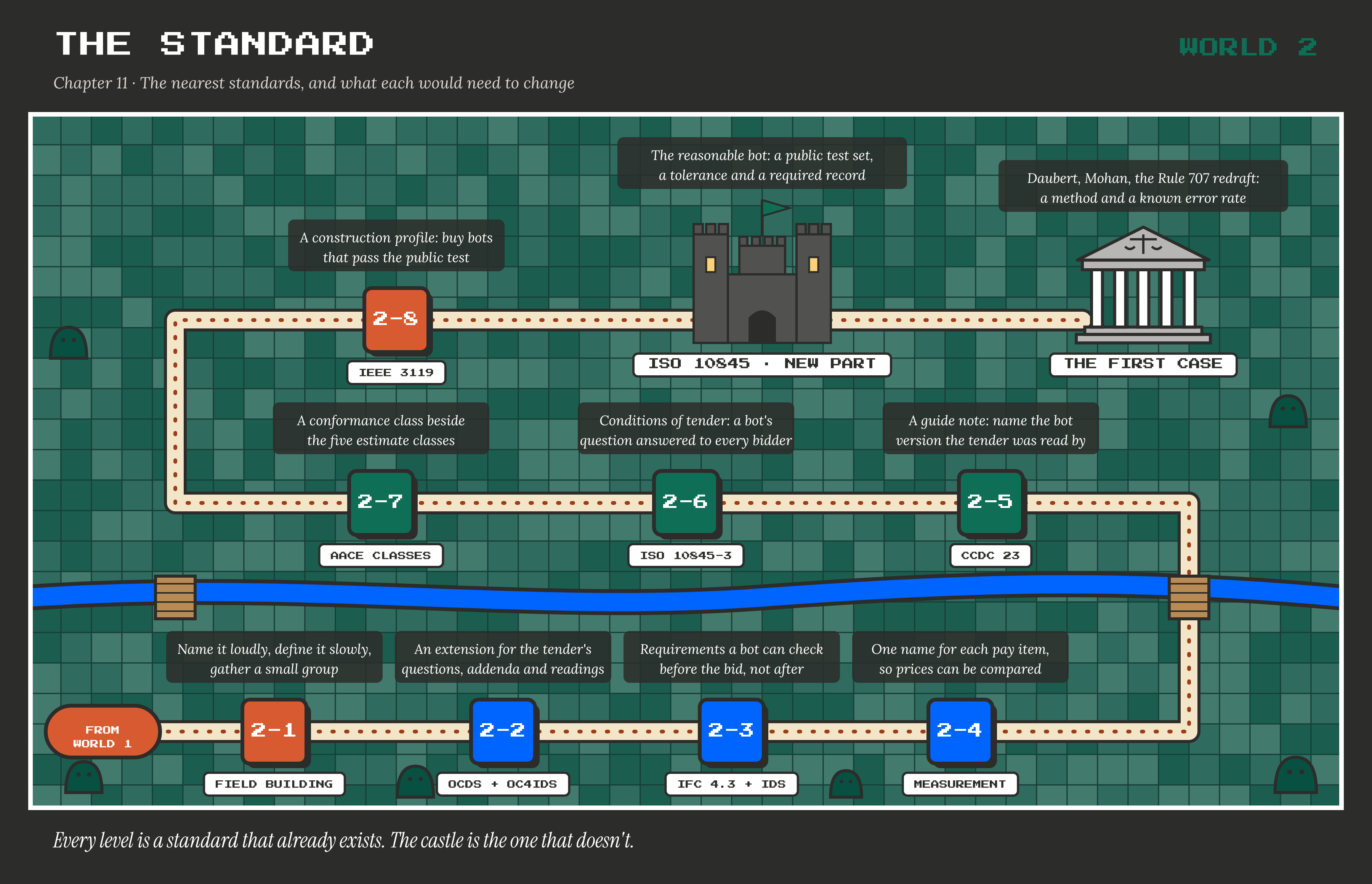
Where the template goes. The pay-item names need a shared list, and the lists already exist: a civil engineering method of measurement like CESMM4, or a state transportation department's catalogue of pay items. The template needs a published crosswalk to them, not a new method. The cost side has a head start: RICS publishes a free data standard, in JSON and XML under an open licence, that already carries the international cost classification, so the template can borrow its names instead of inventing new ones. On the design side, IFC 4.3 already covers roads, rail and bridges, and buildingSMART's Information Delivery Specification, final since June 2024, lets a designer state requirements a program can check; a use case for the items a bidder prices would tie the template's requirement identifiers to the model. The tender rules come next. In Canada, CCDC 23, the guide to calling bids written by a committee of industry associations, could carry a note on issuing the template beside the PDF and naming which one governs. ISO 10845-3, the standard conditions of tender, could add the rule the book gives the buyer's Listener, the bot that collects bidders' questions: a question raised by any bidder's bot is answered to every bidder, by a new version of the template.
Where the record goes. The Open Contracting Data Standard lets anyone write an extension: there is a template on GitHub and a registry kept by the Open Contracting Partnership. An extension for the reading record, and for the questions and versions around it, needs nobody's permission, only work, and it would put the record beside the contract data that governments already publish. On the buyer's side, IEEE 3119, published in 2025, walks a buyer through procuring an AI system, from defining the problem to monitoring the contract. A construction profile could require that any bot the buyer relies on keeps the record.
What waits for the estimator. The test itself has three stops. AACE's estimate classes measure how accurate an estimate can be expected to be, given how far the design has come; a conformance class beside them, agreement with a reference reading under a fixed protocol, is where the book's two to three percent belongs, since it measures something different from distance to the low bid. Stating the error is not the novelty. Since 2021, RICS has required its members to give every cost prediction an estimate of its accuracy, along with the sources of the data behind it. The test is the missing piece, and it has a working cousin next door. Property assessors price every house in a county with a model, and the International Association of Assessing Officers publishes how to score one against the sales that follow. Is the model right on the whole? How widely do its prices scatter? Does it price the expensive houses low? Each question has a published threshold, and a state can order a reappraisal when a county fails. The three questions carry over to tenders unchanged, and the third is the one that catches a bot quietly underpricing the largest contracts. The castle is a new part of ISO 10845 holding the public test set, the tolerance and the record, reached through a national standards body; whether Canada sits on the subcommittee is the first thing to find out, and if it does not, a Canadian mirror committee would itself be a signal. Past the castle is the courthouse. The tests for expert evidence, Daubert in the United States and the line of cases that followed Mohan in Canada, ask for a method that can be tested and a known error rate, and the proposed federal rule on machine-generated evidence, held back in May 2026, is being redrafted. The castle is built so that both answers are on the shelf when the first case arrives.
The order is the pitch. The extension and the crosswalk need nobody's permission, the guide notes and profiles need a membership and a committee, and the castle needs a national body and years. Each level gives the next one something already running.
Getting the asks to stick
Lang borrows his best line on failure from Carl Cargill, a veteran of technology standards work: most standards efforts do not fail in the committee. They fail before it, when nobody launches them, or after it, when the finished standard finds no one who wants it. In Lang's words, "the danger zone for standards is sometimes in the starting but always in the sticking." The old plan was weakest at sticking. It assumed that a good model would stick because it was good, which is the one thing Cargill's history says is not enough.
Sticking is also a waiting game. The courts will not lean on a standard that does not exist yet, a standards body will not write one without a pilot, and a buyer will not fund a pilot without a return it can count. Each is being reasonable, and together they keep the door shut. The way out is a benefit one of them can capture now, and that is the evaluator's job: its savings arrive before any standard does. It is also why the two asks are small. A template and a record cost a buyer little, and they start piling up the evidence every later stop will need.
Lang's 2026 Symposium talk on field building adds the rest of the checklist. Fields do not generate themselves; someone builds them, often an outsider. Name the thing enthusiastically and define it hesitantly, so that "the reasonable bot" can grow into its test set instead of being fixed too early. The book's two names split that advice between them. Bot Construction is the enthusiastic name, for the field that runs from the tender to the robot on site. Bot Procurement is the hesitant one, for the standard, and it will hold only what has been tested. Make artifacts: the estimator is one, the template and the record are two more, and so is this book. Recruit keystone people from neighbouring fields: someone who has sat on a standards committee, a construction lawyer who has argued over a reading, and inside an owner, whoever has to defend a change-order price in a dispute, who knows the pain best and needs no standard to find a reproducible number useful. Beware capture: the likely captor is a platform vendor whose own format becomes the standard by default, which is the strongest reason to keep the template and the record free. The standard is public so anyone can run it. And find the economic flywheel, which Lang says a field cannot live without; here it is the evaluator's savings, the claims never started and the reviews never paid for.
Then there is upkeep. Nadia Eghbal's Working in Public sorts open-source projects by how fast their users and contributors grow. The estimator today is a toy, used and maintained by one person. If the plan works it becomes a stadium, with many users and a few people on the field, and the lasting cost of a stadium is the maintainer's attention, not the first build. A liability standard is most fragile at that stage, because a court needs it to still be there, unchanged, when the claim arrives years later. The CubeSat took about ten years to take off for that reason; as one of its inventors, Jordi Puig-Suari, put it, "People needed to gain some comfort that these standards are going to be around for a while." New versions will need funding, and the pace of revisions will follow the value the market places on the standard. The way out of the stadium is the move Lang describes, into a consortium or a standards body where the people who rely on the standard share its upkeep. IFC, the open format for building models, shows how long that road can be. It began in 1994 as a club of twelve companies invited by one software vendor, and in 1996 it became a neutral alliance because the vendor's own users insisted the format should belong to no one. The buyers came later: the UK did not require shared building models on central government projects until 2016, and the version of IFC that covers roads and bridges became an ISO standard in 2024, thirty years after the first meeting. It is also a reason not to build the castle alone. The neighbouring bodies on the map already meet, and joining one of them may be faster than founding a new one. This book makes the case on its own only because a problem has to be described before anyone can be asked to share it. Owners can help before then: Kelly Roegies's guide to open protocols for governments suggests procurement criteria that reward suppliers who contribute upstream.
The campaign for World 2
The versions in chapter 16 now line up with the two asks.
Version 1.0, momentum. One trade first, probably civil work, where public bid prices already exist. The template published for that trade, with its crosswalk to the pay items. The record kept for every reading, on an offline model whose weights do not change, and the OCDS extension that carries it. A small group of true believers, and this book as the vision paper.
Version 2.0, proof of work. The evaluator in an owner's hands, saving money the owner can count, and the first tenders issued with the template beside the PDF. The asks that need a committee go in: the CCDC note, the ISO 10845-3 clause, the IEEE profile.
Version 3.0, the working model. By now the records hold enough readings to build a test from. The test is written backwards from what it has to catch, not from the estimator's internals, so that a second vendor's bot can pass it too, and it goes looking for its castle.
The prediction can be wrong, and it should say how. If by 2035 no public owner anywhere runs a tender whose questions, addenda, bids and evaluation pass through agents on a published data format, the forecast failed. The standard itself is further out, in the ten to fifteen years the CubeSat suggests, and its first court challenge will probably come before it, from a dispute fought under the old rules.
The model was never going to generate the field. What it can do is give a small group of people a template to issue, a record to keep and something to argue about. That is how a standard starts, and the villagers, as the zombie garden in chapter 15 promised, are the ones who decide whether it sticks.
Source passages (kept until Andre has read the draft)
Claude, 2026-11-06: the draft above uses the two-routes, conformance-test, one-trade, prediction and tolerance-window passages, and touches the exploit passages only for the bounty. The exploit example (Tannu Tuva, value engineering, proposer security), the public ledger and the pinned-and-published horizon are not yet in the draft. Delete what the chapter no longer needs.
Source passages: exploits (to cut and rewrite)
Laid out by Claude on 2026-11-02, from the Scitovsky thread of 1 November 2026. The Scitovsky source is "The Benefits of Asymmetric Markets" (Journal of Economic Perspectives, 1990), listed in Appendix D (Andre, 2026-11-05). Quoted passages are Andre's, copied unchanged from that thread. Notes in italics are Claude's. Andre asked for this discussion to go into the manuscript as the book's example of exploits. Delete this section as the chapter is written.
Why a public standard invites exploits:
There would be the risk of vendors gaming the system, but the below costs bids on line items is evidence that this is already happening. The standards we are working for may need to be accompanied by other AI reviewers to validate proposals and reduce the risks of accepting proposals exploiting the system.
System exploits should be a risk. Based on complex video games, I am thinking about the world modelling series from Paradox games, there is usually sets of rules that allow for outcomes outside the intended framework. [...] Patches fix this, but since there is little real money flowing out of real accounts, the exploits can be fun if not used in a multiplayer game.
The example, in Andre's words. The Luxembourg write-up he remembers has not been found online, so tell it as the author's own memory of the game rather than as a citation:
The main exploit was the paradrop. Surrounding enemy lines with paratroopers would prevent retreats and speed capture enormous territory. There was a step where war was declared against a country that could never be able to attack you. Tanu Tavu?
The Tannu Tuva world conquest write-up is an even better example of the exploitability of computer programs. This was done by observant humans, image what trillions of tokens would do!
Citable versions if wanted. Hearts of Iron IV players conquering the world as Tannu Tuva, a one-province nation, are documented on the Paradox forum ("Tannu Tuva World Conquest", thread 959544; "I managed to world conquest as Tannu Tuva (w/ tutorial)", thread 1500616); the forum blocked automated reading on 2026-11-02, so check the details by hand. Andre, 2026-11-05: the threads he found are not as good as the write-up he remembers, so the Tannu Tuva example may be dropped; not in Appendix D. A Steam thread of 31 January 2018 asks Paradox to fix the "Paradrop England exploit" (steamcommunity.com/app/394360/discussions/0/1700541698681349596). The lesson for the chapter: every move obeys the rules, but together the moves reach an outcome the designers never intended. That is what a bidder can do to a frozen, published standard bot.
Compute is the new asymmetry (Scitovsky's gap between expert and non-expert returns as search power):
AI will cut both ways on this. It will be able to provide more audits from different angles, but the race for compute may advantage the vendors. If spending 1% of project funds on estimating increases marginal profits without lowering costs (see Scitovsky), then we can expect firms to make this choice. (1% = $10,000/$1,000,000 - once projects climb to the multi-million dollar range, pre-paying for estimating compute to exploit the standardized bot will become an issue.
There is high likelihood that additional controls would need to be incorporated in the contracts and tenders to control exploits. Stress testing it against powerful AI could help. This would be expensive and continuous, so legal protections may be required. (Maybe bounties for exploit reveals could be useful? Could many low power reviews form bounty hunters = high powered exploit expedition from a potential bidder?)
Claude's note on bounties: one exploit found and patched protects every tender read against that version, so a bounty can be funded across all of them, while a bidder's exploit search is paid for by a single project. The bounty has to pay more than the exploit is worth to a bidder who keeps it secret.
Where exploits do the most harm:
The exploits would be more of an issue for value engineering proposals than low bid procurement. Exploiting the low bid would likely lead to lower prices (or lower quality). Exploiting value engineering could easily lead to higher costs without benefits when a buyer is bound to a promising idea that fails to deliver.
The control Andre prefers, out of five Claude proposed (a public test set with a private holdout replaced at each version, several independent AI reviewers, proposer security, bounties per version, and a tender clause that readings obtained through a known exploit are not relied on):
Placing the onus on the proponent would allow for an equitable distribution of risks and rewards.
The pass/fail approach for proposals could also help, but the proposer security method helps control for latent risks.
The control in full, as Claude put it in the thread and Andre picked it: "The proposer posts security on its alternative and pays if the owner has to revert." Gaming already has a rule against it in US federal procurement: offers with line items "significantly overstated or understated" must be analysed for unbalanced pricing and may be rejected if the risk is unreasonable (FAR 15.404-1(g)). Fuller notes, with Scitovsky's argument, are in the Claude Doc "The Reasonable Bot, read through Scitovsky" (claude.ai/artifact/YD4MKxFj1b7hvU7MNkhq5x).
Source passages: the protocol (to cut and rewrite)
Laid out by Claude on 2026-11-02. Every quoted passage is Andre's, copied unchanged from the file named under it; the source repository records these as his words, lightly edited from conversation. Where a source says the meaning is Andre's but the wording is Claude's edit (positions §8, horizon.md), the passage is marked "Andre's meaning, edited wording". THESIS passages are Claude's, not Andre's. Notes in italics are Claude's. Delete this section as the chapter is written. The exploit passages above stay where they are.
The prediction
Claude's draft (THESIS section 3), for Andre to rewrite:
The next machine is the one the author's case study proposes: the tender as canonical, versioned, machine-readable data; bidders' bots that read it and choose whether to raise what they find; a Buyer's Listener that turns questions into addenda rather than answers; bids, evaluations and justifications with a signed, citable trail.
The tolerance window: the bot-first protocol card puts first instances at 2028 to 2035, with four confirming signals (a public owner publishing a tender as data; a dispute over an agency's AI, of which Trax v. United States in 2026 is the first; a Canadian mirror committee for construction procurement; an agent-protocol foundation accepting a tender profile). Andre took 10 to 15 years (2036 to 2041) as the working assumption for the standard itself to take effect and perhaps meet its first court challenge (positions §13, placement note, 2026-10-09).
Two routes: bot-readable documents or a standard bot
There are two ways to make this happen: produce specifications and drawings with bot-based APIs, or create a bot standard. With a bot standard, the buyer and consultants would run the tender through the bot and verify that the outputs it generated reflect the design intent. The bot would be available to vendors, but vendors could choose other bots as well. The advantage is a baseline that could be reproduced.
The challenge of that model is verification. The consultants would need to prepare the documents and then check the outputs. That incurs additional cost that the Owner would have to bear. Unless the savings from the bidders are greater than the cost to the consultants, this approach has a misaligned payout structure that will inhibit its adoption.
As a protocol, the standardized bot has the advantage of shifting verification to the side that benefits most from removing discrepancies in the requirements. That would work in favour of adoption even if the cost implications are ambiguous.
Perhaps it is better viewed as a missing-tool issue. The standards could be updated to improve both bot-first specifications and standardized bots. Based on current AI progress, the technological developments needed to make this approach profitable could simply be a matter of time. If the groundwork has been done, the technology would be adopted much faster.
(positions §13, recorded 2026-10-09)
The institute write-up review notes that the prologue leaves out the cost side of these passages (the second paragraph); this chapter is where it belongs.
A conformance test, not a model
Andre's earliest sentence on the idea the outline now calls the conformance test:
I suppose that this could be part of the standard building. A standard battery of tests for bots to sign-off against. This would allow them to provide differentiated results based on bidder preferences while ensuring that the bidder has been made aware these potential discrepancies. There is probably something here, but we will leave its development to future version.
(the collated process note, said 2026-10-06)
The modest path: one trade first
Decomposing a project into requirements for one bid may be the equivalent of using PDFs in the age of scrolling. Perhaps there is a path that falls short of full project bot procurement but allows standards, or a standardized bot, to be applied to a limited scope of work or a trade. Civil work may be a good candidate, thanks to the existing database that could be used to train bots. Surveys could also be a good place to start. Or landscaping?
(positions §15, recorded 2026-10-09)
Claude's comparison there: surveys are the cleanest for verification (the deliverable is a dataset checked against a schema) and the weakest for price data; civil items are the reverse, with the Texas prices this project already uses; landscaping priced as highway items is a low-stakes way into the civil data but the least machine-checkable at acceptance. A scope is ready when the task can be specified in machine terms, an executor found by program, completion verified by machine, and payment follow verification.
A public ledger for the record
More importantly, the use of blockchain, while an unlikely form of payment for public procurement or for major contracts, is interesting because it ties the record to a publicly inspectable source, avoiding the issues with version control that come from depositories or downloads.
(positions §15, recorded 2026-10-09)
Claude's note there: the property needs less than a payment system. A hash of each issued document, written to a public, append-only, timestamped log nobody in the tender controls, proves which version existed when; a transparency log of the kind used for web certificates does this without a currency.
Pinned and published: the horizon past the standard
Andre's meaning, edited wording:
Must-have and critical systems would be pinned; portions of the specification that need a baseline to guide bidders, without needing specific performance, would be published.
In human-led procurement, bid leveling for mild discrepancies between bids is tedious and often delays project implementation. Bots could remedy this, and would allow bidders to submit multiple bids for various combinations of offers: a blend of spec-build and design-build. Value engineering would move to the tender stage, which should allow better matching between vendors and buyers, with benefits to both parties.
The challenge would be building a standard tender format to allow this. Without a standard, the legal battles over an AI's choice of "best" options will certainly be litigated. They will likely be litigated no matter the standard, but standards would open the opportunity to move beyond legal issues into the technical ones, as principles of equity are developed for AI.
(positions §8, recorded 2026-10-05; Andre called it "speculative and long-term at best", a horizon and not a change of approach, decision 48)
The exploit passages above say value engineering is where exploits do the most harm; the pinned-and-published horizon is exactly where value engineering moves to the tender. The chapter can let the two meet.
Why the standards are the end-boss
Andre's meaning, edited wording, on why speculation belongs in the book at all:
A weak point of the whole project is financial compensation. Taking the whole pie would prevent adoption; having no pie will starve the project and keep it from its full potential. Speculation about the future is meant to guess its shape, so that failing to have a slice now does not mean having none later.
(context-bank/horizon.md, "Why speculate at all: the slice of pie", recorded 2026-10-05; the "end-boss" passage from the same file is in chapter 16)
From the Procurement Machines: the projected card
Added 2026-11-02 from the Procurement Machines work package (work-packages/procurement-machines/). The cards, the thread and the watchlist are Claude's drafts from research, for Andre's review; only passages marked as Andre's are his. Card names are given so the chapter can point to Appendix A.
The six tensions on the bot-first card
The card bot-first-procurement-protocol-EXTRAP is the chapter's prediction stated so it can be wrong. Its tensions, in Claude's words except where marked:
- Speed against reviewability: an agent-generated evaluation must still be a record a human board checked (Trax is the first test).
- Disclosure asymmetry: bidders must disclose their AI while agencies' own use is undisclosed.
- Compelled disclosure of deficiencies: answered by Andre's five reasons against (chapter 3).
- Open protocol against platform capture: the first agent-commerce rails are consumer rails built by payment and platform companies. The signal to watch is a government publishing its own bid-and-award schema under an open foundation rather than a vendor's. This tension is the reason the standard should be free and the estimator only its first conforming bot.
- The unpinned specification (Andre's horizon, positions §8): let the specification stay live and bids be multivariate, "and the lowest price stops being computable by a person".
- Packaged for a reasonable human, not a reasonable bot (Andre's, positions §13, quoted above).
Why a better reader does not remove the need for a standard
From the card's notes, Claude's summary of Andre's argument (put it in his words): if models come to read documents as well as a competent person, a standard is still needed for a legal reason, because "a standard says which reading binds, which a better reader cannot supply." Claude's addition there: the law already asks what a reasonable bidder would have understood; a reference bot would define that reading, and its version would have to be pinned and logged in the record, as Trax shows. This is the hinge between this chapter and the witness box (17a, to fold into it).
The tolerance window
The card's window, first instances 2028 to 2035, is Claude's guess, offered so the card can be wrong: "if by 2035 no public owner anywhere runs a tender whose questions, addenda, bids and evaluation are mediated by agents on a published data format, the card was wrong." Andre's own working assumption is 10 to 15 years (2036 to 2041) for the standard to take effect. Research note F reconciles the two: agent-mediated tenders will run on the old rules before any standard exists, so the first precedent comes from Trax-type disputes, not from a standard.
Weights declared before the bids open
The watchlist's expected site "declared weights" (Claude's): best-value evaluations state their factors in prose. A machine-readable declaration, fixed before bids open, "is what would make an AI's choice of best checkable afterwards". It is the precondition for the pinned-and-published horizon above.