Working copy
Draft text, rebuilt from the manuscript on every change. Stubs and source passages are still here, and none of it is final. Back to the working copy contents
Drafted The chapter is written and still being revised.
A second opinion on every price
A tender is a strange kind of market. For a few weeks, a handful of builders study the same drawings, price the same work and seal their numbers in envelopes. On closing day the envelopes are opened, and for one afternoon the buyer knows something it almost never knows: what the work is worth to the people who would actually do it. Then the contract is signed, the losing bidders go home, and the market leaves the room.
It does not come back. Halfway through the job the excavator meets rock that the borehole logs missed, or the owner decides the lobby needs a second door, and the builder sends in a price for the change. Nobody else is invited to quote, because the builder already on site is the only one who can do the work without tripping over everyone else, and both sides know it. Every change after award is a purchase from a supplier of one.
This chapter is about two bots built to live on either side of that afternoon. The estimator asks its question before the tender: how much should this cost? The Fair and Reasonable Evaluator asks it after: are we paying too much? They began as two tools and turned out to be one engine pointed in two directions, so entangled that it is hard to describe one without the other. The estimator came first and gets most of the attention, but the evaluator is where the money is, because its benefits arrive after the tender, where the market can no longer help.
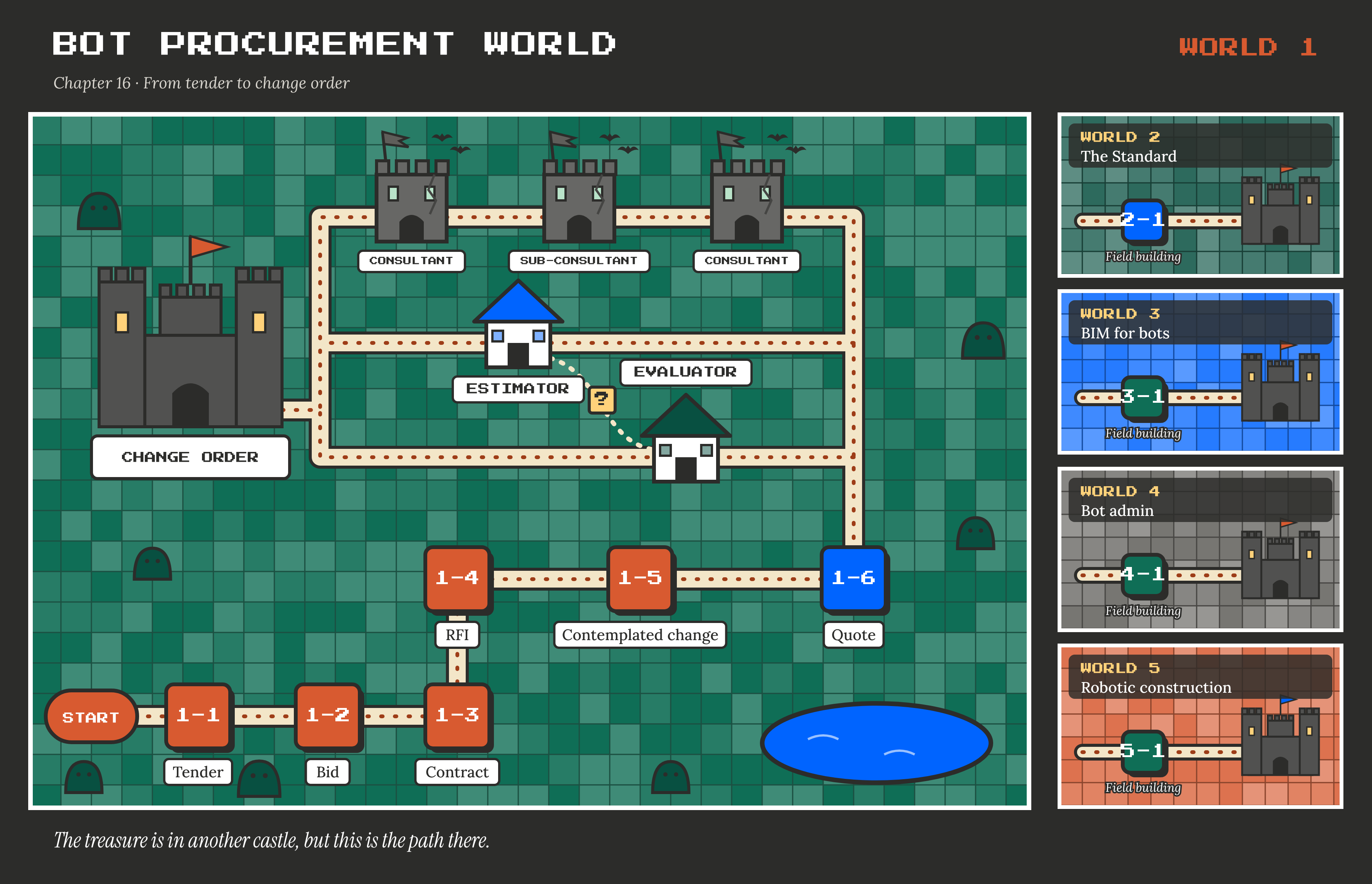
The map below draws that afternoon, and everything after it, as the first world of an old-fashioned game. The road starts at the tender and runs through the bid and the contract, the three levels where the market is still in the room. Then it turns north into the levels every project ends up playing: a request for information, a contemplated change, and the builder's quote. At the quote the road splits three ways, and all three lead to the same castle, the change order, where somebody has to sign. The rest of this chapter walks those roads.
The slow road
When the market leaves, someone has to take its place. A public buyer cannot simply accept the builder's price for a change. It has to show, in writing, that the price is fair and reasonable, and private owners who answer to a board or a lender end up playing the same level under another name. The justification is a short essay on what the work should have cost, built from old tenders, price books and judgment.
In practice the essay is written by whoever has time, which is usually no one. The owner's own reviewers are efficient but busy, so the hard reviews go down the pipe to consultants, who often send them further down to sub-consultants. On the map this is the long road across the top, a row of haunted fortresses: the consultant, the sub-consultant, and the consultant again, who has to read what came back up before passing it on. Every fortress adds its own review, its own correspondence and its own invoice. In my experience the standard for a consultant's review is ten working days, but that is a service standard, not a timer, and almost no review runs the clock down to zero.
The clock is rarely the claim either, because the contractor has usually been warned about the review and cannot claim against it. The danger is motivation. Most contractors are happy to clear the level with their margins and move on, and they only go looking for hidden blocks, the spurious claims, when something motivates them. A project that slows production on every change, while its overhead keeps climbing, hands them that motivation, and a motivated contractor can always find a block worth hitting, in the change itself if needed or in any other claimable delay on the job. This is not standard practice, and the courts may eventually decide against the contractor, but why would anyone want to play that level at all if a cheap, simple tool can prevent it?
The labour is the steadier cost: a few coins lost on every change rather than a life lost all at once. In my experience each change takes an hour or more of someone's time to review, at $150 to $200 an hour, and a million-dollar project can see 50 to 100 changes, which puts the review bill between $7,500 and $20,000 for every million dollars of work. Set against that, a tool that answers in minutes does not need a perfect run. Even if a 10 percent error rate led to some minor overpayments, a tool for instant responses would pay for itself the first time it kept a contractor from finding a reason to claim. The consultants' reviews I have seen cost 2 to 10 percent of the work they check, so at the top of that range the review costs about as much as the tool would get wrong.
That is why the two roads below the fortresses lead to huts instead: shorter roads, one stop each, and the same castle at the end.
Built for bidders
The obvious question is why nobody uses the estimating software that already exists. There are good tools for pricing construction, but they need structured data, and almost all of them are built for bidders. A bidder's question is whether it has priced low enough to win and high enough not to lose money, and its software is built to check that it is not underbidding. The evaluator's question runs the other way. It wants a program that looks backwards at what the market has already paid, to make sure the buyer is not overpaying based on market rates. Add the usual lock-in that comes with a vendor's price book, and the bidder's tools turn out to answer the wrong question for the wrong person.
The data requirement is the harder limit. Owners' records are not standard, because every project arrives with its own consultants, its own stakeholders, its own forms and its own way of describing the same trench, so the history that should teach a tool the market is locked inside thousands of PDFs, the same zombies we met in the garden of chapter 15. There are three ways out. The owner can mandate standard documents, which works but takes years. Staff can convert old records by hand, which works but costs more than the tool would save. Or an AI can do the conversion, reading each old tender and filling one standard table, with a person checking each file before it is used.
The third is the newest and least proven, and it is the one this project is betting on. Assistants like Copilot and Claude can already read a messy bid summary and fill a table from it. What they cannot yet do is promise they read it right, which is why the person checking each file stays in the loop.
There is a harder version of the same problem. The data this project was built on is the easy case: every contract is tendered line by line, so every item carries its own price. Many owners do not tender that way. Their contracts are priced as lump sums or a few large parts, so before an evaluator can price a change it has to read the contract, find past work that looks like it, and combine those prices into an answer. That is the tool worth building: one that looks at the contracts, knows past prices for similar work, and can combine them into something that saves people labour. Matching work to similar work is reading, not arithmetic, and it is where the AI earns its place.
Why the estimator came first
On paper the evaluator should have been built first. Since the whole process is untested and the best practices for this kind of system are still being written, a simpler owner-side bot would have been a training ground for building bots and the systems around them. If human engineering provides an appropriate analogy, the evaluator would only need to analyze, while the estimator would need to design.
Then the project found the Texas Department of Transportation's open bid tabulations, about a million prices with every bidder's price for every line of every highway contract the state had let in two years, alongside its engineers' own estimate. That gave enough depth to go straight to the estimator. Since the estimator is the more complex of the two, the reviewer could be based on its work, and two days after the decision to start there, in early October 2026, the evaluator was folded into the estimator's plan as a second use of the same model.
That is where the entanglement begins. On the map the two bots are two huts on neighbouring roads, the estimator's and the evaluator's, joined by a secret path of the kind a player only finds after hitting the right block. The estimator's price for a line is the evaluator's reference for the same line, and the estimator's error rate is the evaluator's tolerance. If the estimator says a tonne of asphalt should cost about $95 and is usually right within 20 percent, the evaluator can look at a change priced at $105 and call it within range, and look at one priced at $150 and say someone should ask why. It should ask the same question of a change priced at $50. A price that low is rarely a gift: either the builder has misread the work, or it plans to make up the difference somewhere else, and a builder losing money on a change is the motivated contractor from the slow road. A better estimator makes a sharper evaluator, and every price the evaluator checks after award becomes evidence for the next estimate. The arithmetic belongs more naturally to the evaluator, because its question ends in a yes or a no, but the two bots share it.
What the scores say
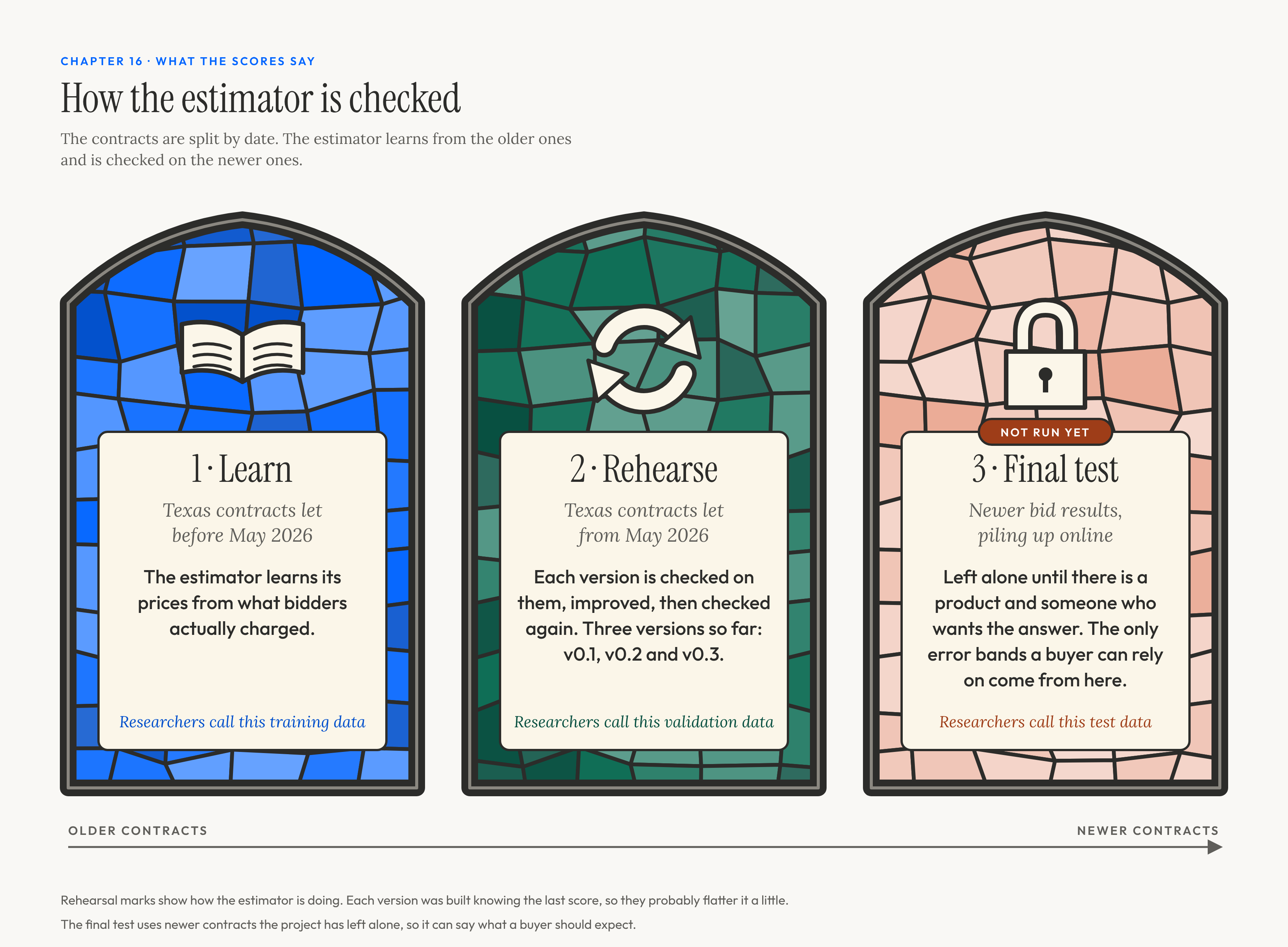
The estimator learned from Texas contracts let before May 2026. The contracts let from May 2026 on were set aside as a rehearsal, the way a student sits a practice exam before the real one. Three versions were checked against them in October 2026, and the third is the one worth reporting.
Line by line, it missed the average of the three lowest bids by a median of 21 percent, against 29 percent for the engineer's estimate, the price the state's own engineers put on the work before the tender. For a whole contract, where the errors on single lines partly cancel, its price typically missed what the lowest bidders bid by about 10 percent, level with the engineer's estimate. That may sound loose until you look at the bidders themselves: on the same lines, the three lowest disagree with each other by a median of 50 percent.
The scores also lean, and they lean low. On whole contracts, the estimator's total came in under the average of the three lowest bids on 64 percent of the rehearsal contracts, and more than a quarter under on 11 percent. The engineer's estimate came in under on 41 percent, and more than a quarter under on 6 percent. That is what the project expected, because it started with a floor. The estimator is built to predict what the lowest bidders charge, the bottom of the market rather than its middle, so the prototype was always going to sit low. Part of the lean has a plainer cause: prices rose during the rehearsal months, and the estimator's history stopped in April 2026, with nothing to bring it up to date. A floor says what the work is unlikely to cost less than, which is the right place for a check to start. It is the wrong place to bid from, and a reference that sits low makes a dangerously low bid look normal, so later versions will have to move toward the middle or say plainly where they sit. Chapter 3 shows how often human prices run that low.
The scores show two things: the method works on contracts it was not trained on, and its error is known on the rehearsal contracts. They are rehearsal marks, because each version was built knowing how the last one scored, so they probably flatter the estimator a little, by an amount nobody has measured. The real exam is a final test on newer contracts the project has left alone. Bid results keep piling up online, and the project will run the estimator on them once there is a product and someone interested in the answer. The scores do not yet prove that someone outside the project can rerun them and get the same answer, or that a court would accept the number, which chapter 17 argues is a different property altogether. The long-term aim is 2 to 3 percent, about the tolerance a contractor prices to, at which point an estimate could stand on its own. Until then it is a second opinion.
The tool drafts, a person decides
A second opinion is only useful if someone has to act on it. Brazil and Korea both built machines that read public tenders and flagged the suspicious ones, and both machines sat nearly unused for years (Appendix A has their card). Korea's flagged about ten thousand tenders in its first decade, and its competition authority investigated seven. Brazil's auditors found theirs in disuse in 2018, and their own diagnosis was that the technology worked but no process obliged anyone to follow the flags. A flag that nobody owns costs nothing to ignore: no one answers for missing it, so a busy office misses it, and after a while nobody remembers why the machine was built. Brazil's came back when a critical flag began opening an audit task that someone had to close. Korea's came back after a parliamentary audit forced a rebuild. A flag without an owner is a flag nobody reads.
So the evaluator is designed around the person who signs. It prices each line of a change, drafts the fair-and-reasonable memo and hands it to a named reviewer, the keyholder at the castle gate, who reviews, decides and signs, with a reason. Every price in the memo cites the past tenders behind it, with the contract, its date, the item and the prices used, so the reviewer can go back to the source instead of trusting a number. Items the tool has seen too rarely are flagged, never silently priced. Each request is logged with who asked, when, which version of the model answered, what was flagged and what the reviewer decided and why, in a chained record where a later edit would show.
When an AI reads the data or outsiders see the results, the design keeps two bots apart: a Witness that reads the records and an Oracle that checks what leaves, so the bot that faces outward never touches the files. A buyer running a plain program on its own computer, on its own records, needs a simpler safeguard: the AI builds the tool, and it does not read the data. Claude writes and tests the program on public data, and only the code, which carries no data, moves onto the owner's computer to read the owner's records where they sit. The Witness and the Oracle wait in the design for the day the evaluator reaches beyond one owner.
The flywheel
The standards were always going to be the end-boss. Early in the journey it was too soon to know whether that fight would be worth it, so the plan treated it as a side quest. If the doors opened easily, early work with the standards organizations could give the project a lot of energy. If it was hard, or the project fizzled, there would still be an artifact: the estimator, as a souvenir.
The souvenir has become the flywheel, and the evaluator is what gives it its first push. Each version has its own job. Version 1.0 builds momentum by being something people can use. Version 2.0 is proof of work that the project brings tangible benefits, and that is the evaluator's job, because the benefits a buyer can count, the claims never started and the reviews not paid for, arrive after the tender. The builder can count some too: a change approved in days instead of weeks is paid sooner and carries less overhead. Version 3.0 is a working model from which the first standard can be reverse-engineered. Each turn feeds the next: a working tool on public data proves the method, a published and versioned test lets others check it, and owners who adopt it produce standard records, which make the next tool cheaper and more accurate. The first one runs on an offline model whose weights do not change, so a reading made today can be rerun next year. It is the proof of concept that starts the flywheel, and it scales only if demand justifies the investment.
None of this is free for the builder, and the book should not pretend otherwise. The estimator narrows the cushion a bidder carries into the tender, and the evaluator narrows what a builder could once make up on changes after award. Whether margins shrink at all depends on the market. With many bidders chasing every job, the owner gains leverage; with two or three, it mostly gains information. But a pair of bots that only ever cut would hand every contractor the motivation the slow road warns about, and a reason to start talking to its competitors. Chapter 3 sketched the answer. A builder who cannot win on price can still win on ideas, if the tender has a way to accept a better solution and to pay its author for it.
The evaluator is only the first step toward a fully automated estimator. Building it will open the door to the next, and behind that door is the standard, which is World 2 on the map and where the book goes next. Past it lie the worlds this book can only point at: BIM for bots, bot admin and, furthest out, robotic construction, each with its own field-building level to clear before its castle.
The treasure is in another castle, but this is the path there.