Working copy
Draft text, rebuilt from the manuscript on every change. Stubs and source passages are still here, and none of it is final. Back to the working copy contents
Drafted The chapter is written and still being revised.
The buyers: more bids than eyes
Chapter 4 sorted buyers by how they hire. This chapter sorts them by what their door looks like when the thicket arrives, because the flood does not land on every buyer the same way.
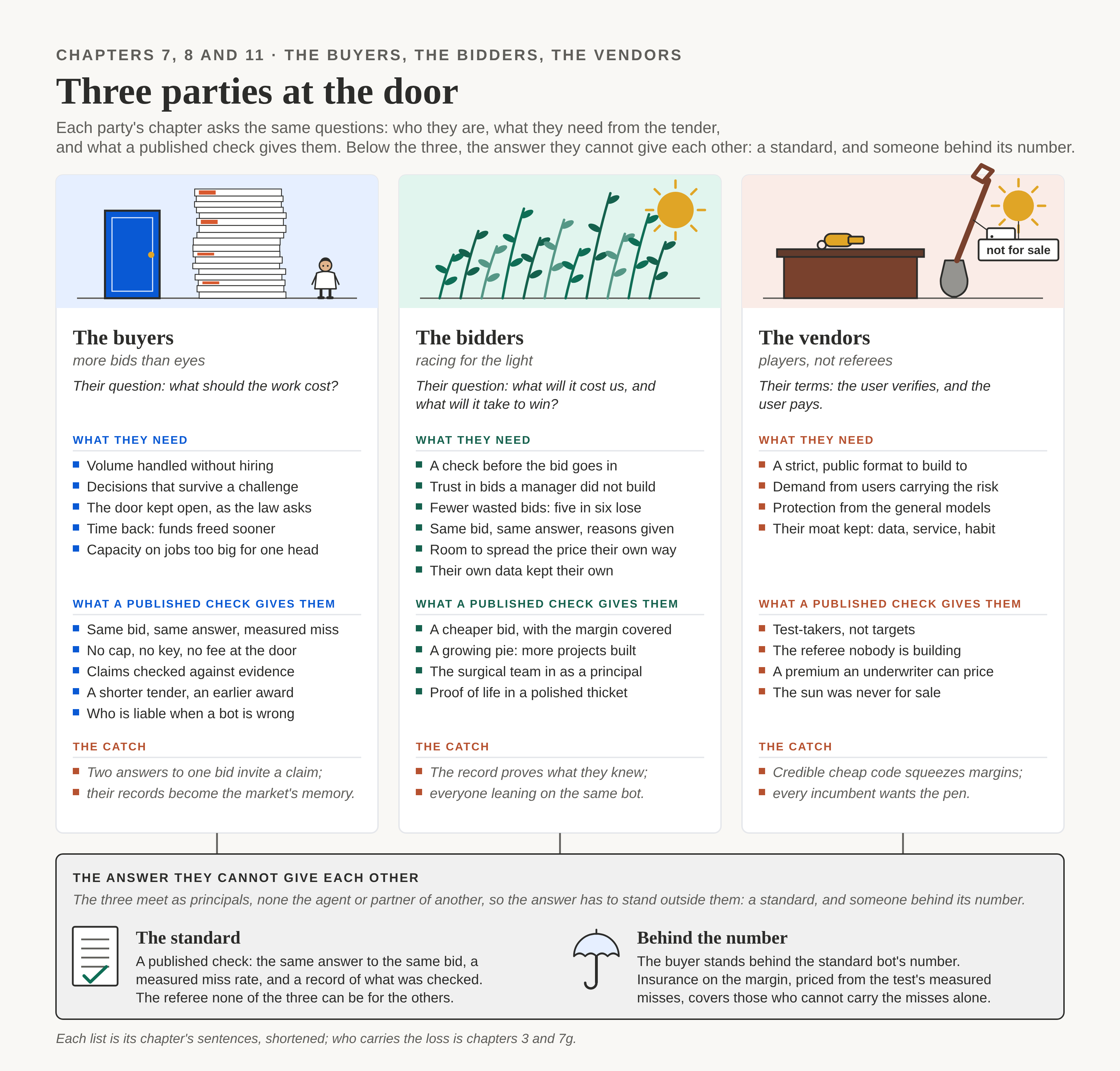
The highway agency has the best door in the industry. It measures the work itself and publishes the quantities, so a bid is a price per item and already travels as a data file. It prequalifies bidders, takes a bond, and writes down its reasons when a bid looks odd. Its priced bids have not been shown to flood, and a bot can read them today. Its trouble is the written parts, the design-build proposals and the statements of qualifications, and the question of what it does when the lettings draw twice the bids and the staff does not grow.
The public building owner has the worst door. A school, a hospital or a water plant goes out as a set of drawings and a book of specifications, each bidder measures its own quantities, and the bids come back as PDFs. The evaluation is reading, all of it, and the structure that lets a highway bid be checked by machine is missing. This is where more bids cost the most eyes.
The procurer of a megaproject has a door that few people knock on. Public-private partnerships and large design-build jobs take months or years to procure, and in Ontario the firms answering the province's calls fell from more than five to about two and a half in a decade, with four billion-dollar projects drawing a single bid each. The flood here does not look like numbers. It looks like polish. The major companies will now be able to ask AI to structure their quotes, proposals and the technical portions of their bid packages to near-perfect matches to the criteria.
The private owner can shut the door whenever it likes. A private buyer can decide that they are willing to pay a premium to only consider established companies. The public sector would find itself in a conflict of principles. What the private owner wants is different too: speed and confidence, not a decision that survives a protest.
The fifth buyer is the one from chapter 4 who buys on someone else's behalf. The Construction Manager and the owner's Consultant answer to the owner for every award, and their discretion is the first thing a losing bidder questions.
What they need
The public buyers need to handle volume without hiring. In the public sector, the need to prevent nepotism and bid-fixing, while offering the opportunity to bid to the widest possible array of the population, is served by the increased number of bidders. But increasing staffing for human review may prove to be politically sensitive, and chapter 1 gave the question the public would rightfully ask.
They need decisions that survive a challenge. Without a standard, AI scoring would invite a claim, and the law of protests shows why the flood makes it worse. In the United States, a protester that shows two proposals were substantively indistinguishable but scored differently can win, and a single inconsistency between two evaluations has been enough to sustain a protest. The more alike the proposals, the more every small difference in scoring matters, and AI makes proposals alike. A need to validate the claims made by polished language would need a standard approach, or else bidders would argue that the wording of their submission should have given them the same technical scores as the winner's. AI may be even more essential as a back-checker of claims than as a writer of them.
They need the door kept open. Trade law has already settled the conflict of principles the private owner is spared. A public buyer may ask for capacity that fits the job, but not for a firm to be established: conditions must be essential, prior contracts cannot be required, and a shortlist is allowed only when it is announced with its criteria. Europe caps the turnover a buyer may demand at twice the contract's value, and a proposal before its parliament and council would cut that to half, bar most requirements of prior public-sector experience, and let a buyer draw lots when too many qualified firms apply. The law leaves the public buyer one answer to the flood, and it is the fourth one.
They need time back. Tenders cost money to run and, more importantly, take time. Buyers need to set aside the funding for the work to ensure payments can be made, and that money cannot be allocated to other work at the same time. Accelerating the tender process will lead to faster overall project life cycles and faster acquisition of the project's benefits, allowing more projects to be built.
And on the largest jobs they need capacity of a kind no hiring can supply. Multi-billion dollar projects are already outside the ability of one human to hold in their head. They generate human-based hallucinations on the part of the participants, and the hallucinations are controlled by multiple parties acting as a GAN to each other, each checking the other's output. AI will be a capacity enhancer if the risk of its own hallucinations can be mitigated or covered through insurance. One caution belongs here: parties checking each other catch mistakes only if their errors are independent. If the designer, the bidder and the owner run the same model, their blind spots line up, and the GAN becomes a mirror.
What a standard does for them
A published check turns the probabilistic objection around. Strict tender rules exist to take discretion away from officials. A tool that can give two answers to the same bid brings discretion back through whoever overrides it, and that is the claim waiting to happen. A check that is published, gives the same answer to the same bid, and carries a measured miss rate stays on the rules' side of the line. The person still signs the award, as a highway engineer signs the written justification today, but what they sign is a rule applied, not a judgment made.
It keeps the door open without a cap, a key or a fee. The buyer that can check a thousand bids the same way does not need to limit who may send one, which is the only answer the law was going to allow anyway.
It checks claims against evidence rather than prose. A statement of experience points at a contract that exists; a price points at the market's record of what the work has cost. Polish stops mattering, which is the point.
It gives time back in the order the budget feels it: a shorter tender, an earlier award, funds released sooner for the next project.
The private owner gains the same check as an option and keeps its freedom to narrow the door. What it gets that it cannot buy today is a bid it can compare across firms on the same terms, and a known answer to who is liable when a bot somewhere in the chain is wrong, which is the question chapter 3 takes up.
The buyers' part of the convergence is the one they will like least. The market's memory is made of their records. Every bid tabulation they publish, with a licence that lets anyone read it, is a line in the memory the check reads against, and every one they keep behind a paywall or in a PDF is a line the thicket grows into instead.